During the years of the Nazi occupation of the island of Jersey, when Claude Cahun and Marcel Moore were engaged in resistance activities, the two women came across a photograph in a German magazine depicting a group of German soldiers marching, their uniforms caked in mud. They decided to cut the image in half, keeping only the lower portion, thus transforming the representation of the German army into an image of dirt and filth. Cahun then inscribed the German words “ohne Ende” in red paint across the image. As Cahun herself recounts in a long letter to Gaston Ferdière dated March 1946:
See J. H. Jackson, Paper Bullets. Two Artists Who Risked Their Lives to Defy the Nazis, Chapel Hill, Algonquin, 2020.
Je […] cherchai une présentation esthétique. Je trouvai un joli cadre à la taille voulue. Il contenait une photo d’Oscar Wilde et Alfred Douglas—l’ensemble datait de si loin que je l’avais presque oublié, gardé je ne sais pourquoi si ce n’est que la place dans les placards ne manquait ni à Nantes ni ici. J’ouvris le cadre, substituai la photo des bottes à la photo de 1892 et recollai.
C. Cahun, Écrits, édition présentée et établie par F. Leperlier, Paris, Jean-Michel Place, 2002, p. 681.
Cahun and Moore then hung the altered image on the wall of a house occupied by German soldiers, with the aim of undermining their morale and encouraging defection. This act was just one of the many instances of sabotage the two women carried out during those years, up until their arrest in 1944. Although most of the photomontages they produced during this period were unfortunately destroyed, they remain as spectral examples of a mode of political struggle grounded in—and perhaps above all constituted by—the montage of words and images.
Already in her 1934 pamphlet Les paris sont ouverts, Cahun had reflected on revolutionary poetry through a photographic metaphor. The pamphlet was originally written as a report intended for the literary section of the AEAR (Association des écrivains et artistes révolutionnaires), and openly challenged the positions of Louis Aragon and the cultural line of the French Communist Party. It marked Cahun’s increasing proximity to the Surrealist movement and to certain positions held by André Breton. In discussing the question of poetic commitment, Cahun draws on a well-known essay by Tristan Tzara, published in December 1931 in the journal Le Surréalisme au service de la révolution, in which the Dadaist founder, engaging with psychoanalytic thought and dialectical materialism, distinguishes between “pensée dirigée”, aligned with logic, and “pensée non dirigée”, associated with dreaming. This distinction serves to identify two types of poetry, or rather, two conceptualizations of poetry: poetry as a means of expression, on the one hand, and poetry as a spiritual activity, on the other. “On remarquera d’un coté la prépondérance du langage systématiquement logique, le penser en paroles, instrument de ce penser au sein duquel il s’est perfectionné,” Tzara writes, “et de l’autre coté les caractéristiques du penser qui consiste en une succession d’images.”
Drawing on this very distinction, Cahun, in Les paris sont ouverts, differentiates between the manifest and latent content of poetic writing, identifying three modes of poetic action: “l’action directe, par affirmation et reiteration”, “l’action directe à contre-sens, par provocation”, and “l’action indirecte”; it is this third mode that Cahun regards as truly revolutionary poetry—the one that draws its power from the latent content, from poetry as a spiritual activity. And to explain how it works, Cahun significantly turns to a photographic image:
For the importance of montage in the political thought of the 1920s and 1930s, it is enough to recall the theories of Walter Benjamin and Bertolt Brecht, among others.
See F. Leperlier, Claude Cahun. L’Exotisme intérieur, Paris, Fayard, 2006, p. 279.
T. Tzara, ‘Essai sur la situation de la poésie’, Le Surréalisme au service de la revolution, 4, 1931, p. 19.
C. Cahun, Les paris sont ouverts, Paris, José Corti, 1934, p. 11.
Ivi, p. 13.
Ivi, p. 14.
Il serait utile de faire, d’autre part, l’analyse de poèmes activité d’esprit. Leur traduction produirait parfois, j’en suis persuadée, des révélations de ce genre : Un homme a cru photographier les cheveux mêlés de brins de paille de la femme qu’il aime, endormie dans un champ. Le cliché révélé, apparaissent mille bras divergents, des poings brillants, des armes ; on s’aperçoit qu’il s’agit d’une émeute.
Ivi, p. 10.
This is a passage largely overlooked by critics, yet I believe it is particularly significant, precisely because it employs a reference—or, if one prefers, a metaphor—drawn from photography to articulate the notion of poetic commitment and action. In this paper, I aim to show how Cahun had already enacted these theoretical premises in her most challenging and compelling work, Aveux non avenus (1930), where the poetics of montage functions as a political reagent. One need only consider the plate that opens the second chapter [Fig. 1]:
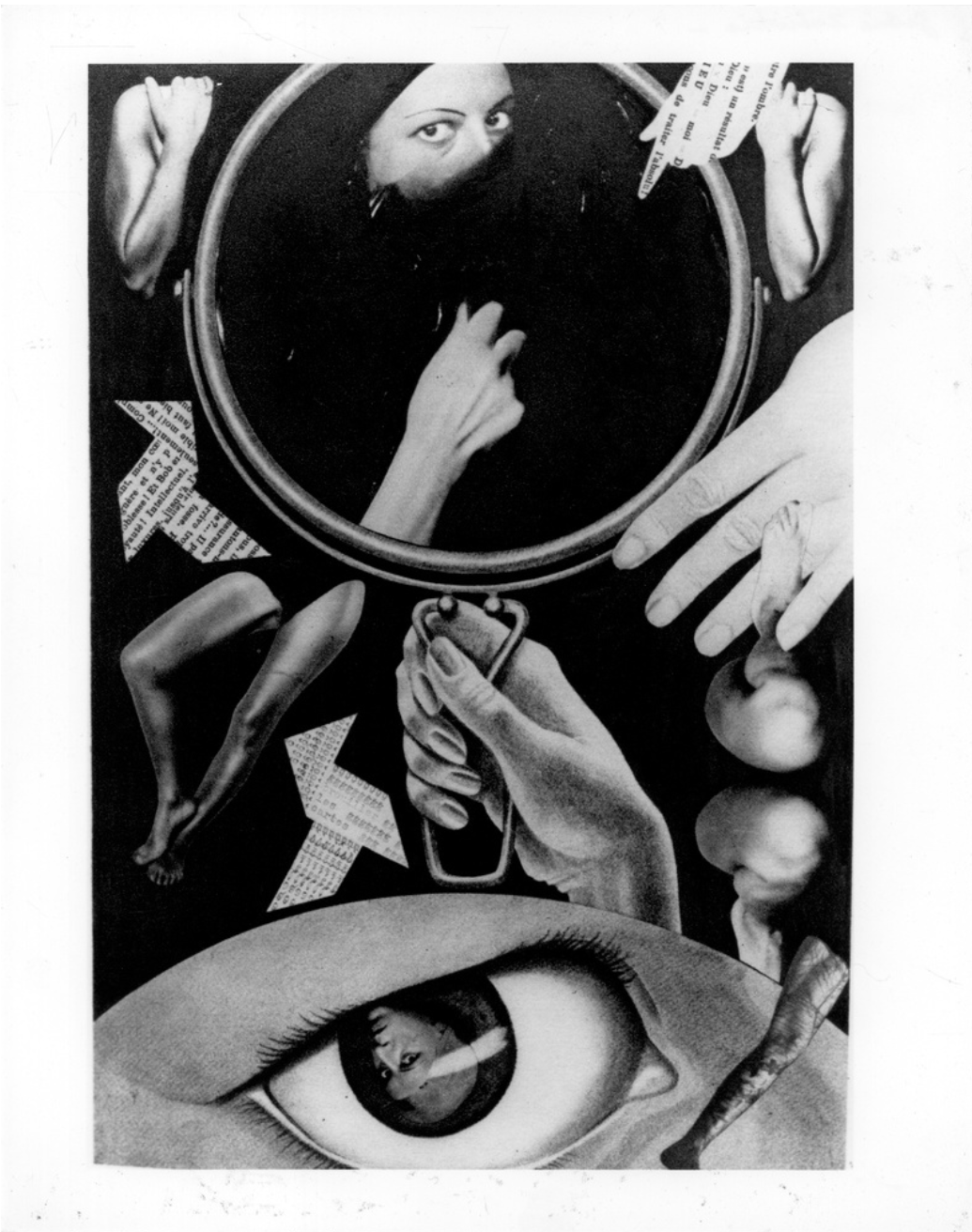
Fig. 1 Planche III d'Aveux non Avenus, © Frank Pellois/Bibliothèque municipale de Nantes
As with all the photographs in the book, each image functions as a kind of fractal of the entire work, in which Cahun and Moore visually condense the methods and themes explored throughout. Alessandro Nigro has noted that the ten photo-plates can be grouped into at least three distinct types of montage:
On the topic of collaboration between Cahun and Moore, and co-authorship, see J. Cole, ‘Claude Cahun, Marcel Moore, and the collaborative construction of a Lesbian Subjectivity’, in N. Broude, M. D. Garrad (eds), Reclaiming Female Agency. Feminist Art History After Postmodernism, Berkely Los Angeles, U of California P, 2005, pp. 343-360. See also, for different perspectives, L. Downie (ed.), Don’t Kiss Me: The Art of Claude Cahun and Marcel Moore, London, Tate Gallery Publishing, 2006.
the montage of photographic details aimed at presenting the artist’s body in fragmented, hybrid, or distorted forms, in the vein of the anamorphic self-portrait published in the journal Bifur; the paratactic juxtaposition of photographic images, drawings, and textual fragments, yielding an effect not unlike that of a photo album or scrapbook; finally, the evocation of dreamlike and enigmatic iconographies reminiscent of the atmosphere in de Chirico’s paintings or the récits de rêve published in Surrealist journals.
A. Nigro, Fotografia e fotomontaggio nella Parigi di André Breton, Padova, Cluep, 2015, pp. 174-6. All translations from Italian are mine.
In the case of this particular plate, one metapoetic detail stands out: a paper hand pointing to the image itself. This hand is a cut-out from the text, assuming anatomical form and signaling the overlap between life and work, between body and page—an embodiment within the text. This gesture of pointing—indication in both the literal and interpretive senses—alerts the viewer to the need for a reading that attends closely to the icono-textual dynamics. It also offers interpretive cues: the fragmentation of the body (evoking a kind of Frankenstein figure to be reassembled); the conflation of I and eye and thus the positionality of the gaze, which, crucially, is also a reciprocal gaze between two women. This destabilizes any fixed distinction between subject and object: Who is looking? Who is being looked at?. This oblique, marginal, and (one might say) gendered positioning of the gaze is thematized in the pages that immediately follow. In one fragment we read: “on n’apprend à se voir que par quelque judas”, where the polysemy of the word “judas” suggests both a peephole and the betrayal implicit in the act of looking—its moral ambiguity. This marginality, presented through a confined, uncomfortable, and limiting point of view, is almost always embodied: “En regardant par le trou du nombril […] Le mystère, c’est la serrure à laquelle un œil, faute de mieux, sert de passe-partout”. In the photomontage, the theme of the gaze is further amplified by the visual motif of the mirror—one of the book’s central symbols. The image of the mirror conjures two almost opposing conceptions. On the one hand, it evokes themes of vanity and the construction of femininity—recalling, as critics have often noted, Joan Rivière’s seminal 1929 essay Womanliness as a Masquerade. On the other hand, the mirror also suggests the distortion of reflection: the possibility of becoming other. In Western tradition, this motif has long served a “cognitive and corrective” function, dating back to Leonardo da Vinci’s Treatise on Painting. As Andrea Pinotti reminds us, “in the doubling produced by the mirror, a kind of Verfremdung, an estrangement or alienation, takes place.” This is precisely what happens, for instance, to the protagonist of Luigi Pirandello’s One, No One and One Hundred Thousand, or to Freud himself, who in his essay The Uncanny recounts an episode of disorientation caused by the distorted and unrecognizable sight of his own reflection in a mirror:
C. Cahun, Aveux non avenus, Paris, Editions Mille et une nuit, 2011, p. 38.
Ivi, p. 144.
J. Rivière, ‘Womanliness as a Masquerade,’ International Journal of Psychoanalysis, 10, 1929, pp. 303-313.
A. Pinotti, Alla soglia dell’immagine. Da Narciso alla realtà virtuale, Torino, Einaudi, 2020, p. 28.
Ibidem.
I was sitting alone in my sleeping compartment when the train lurched violently. The door of the adjacent toilet swung open and an elderly gentleman in a dressing gown and travelling cap entered my compartment. I assumed that o leaving the toilet, which was located between the two compartments, he had turned the wrong way and entered mine by mistake. I jumped up to put him right, but soon realized to my astonishment that the intruder was my own image, reflected in the mirror on the connecting door. I can still recall that I found his appearance thoroughly unpleasant.
S. Freud, The Uncanny, London, Penguin, 2003, p. 162.
The image of the mirror—or more precisely, the experience of reflection and doubling—thus occupies a crucial intersection of antinomic pairs: especially identity/alterity, self/other. This reciprocal inversion between the self and the other informs two central dimensions of Cahun’s work: the possibility of becoming other, of existing otherwise, and the possibility of recognizing oneself in another. These are, not by chance, two issues that would become central in many theoretical formulations of second-wave feminism—one need only think of Luce Irigaray’s celebrated Speculum, or Carla Lonzi’s diary (Taci, anzi parla), or the now-forgotten but beautiful book by Armanda Guiducci, La mela e il serpent. Autoanalisi di una donna (The Apple and the Serpent. Self-analysis of a Woman, 1974), where one reads: “It is not a mirror, I repeat, it is a door, a frontier between two realities. From my reflected image, no narcissism, no flirtatious joy: only magical cravings, a fabulous desire for elsewhere—elsewhere from the dark room with its sealed walls, from the box of the endless afternoon until twilight growls over the courtyard the hour of bedtime and the white darkness dances upon my black fear.”
This last quotation captures with precision some of the central questions raised by the image of the reflection as the possibility of becoming other. Returning to Cahun, this first dimension is clearly exemplified in the short story Aurige, which opens Part IV of Aveux non avenus. It recounts a triangular relationship between a Poet, Auriga, and a Master—an allegorical framework which, as Jennifer Shaw has noted, allows Cahun to imagine an alternate universe in which subjectivity is not coercively structured by stereotypical or normative images. In this process, the image of reflection in the mirror plays a central role, as made explicit in the closing lines of the story’s first paragraph, significantly titled Portrait: “Car devant son miroir Aurige est touchée de la grâce. Elle consent à se reconnaitre. Et l’illusion qu’elle crée pour elle-même s’étend à quelques autres.”
The mirror radically transforms Auriga’s self-image: where the initial description lingers on her “seins superflus; les dents irrégulières, inefficaces; les yeux et les cheveux du ton le plus banal ; des mains assez fines, mai tordues, déformées. La tête ovale de l’esclave ; le front trop haut,” the optical device of the mirror opens the possibility of becoming other—of beauty and grace re-emerging through distortion.
Equally significant is the second dimension of this mirrored reversal: the possibility of seeing oneself in another—more often, in another woman—through a process of mutual reflection. This dynamic is especially evident in Cahun’s relationship with Marcel Moore, which is marked by the same dialectic of identity (shared gender) and alterity (two distinct individuals) that characterizes mirrored imagery.
Consider, for instance, the following passage, where two heads blur into one as they look at a photograph:
See Pinotti, Alla soglia dell’immagine, p. 29.
A. Guiducci, La mela e il serpente. Autoanalisi di una donna, Milano, nottetempo, p. 104.
J. Shaw, Reading Claude Cahun’s Disavowals, Routledge, p. 139.
Cahun, Aveux non avenus, p. 61.
Ibidem.
[…] la minute où nos deux têtes (ah ! que nos cheveux s’emmêlent indébrouillablement) se penchèrent sur une photographie. Portrait de l’un ou de l’autre nos deux narcissismes s’y noyant, c’était l’impossible réalisé en un miroir magique.
Ivi, p. 23.
If we return to the photomontage from which this analysis began, in light of the considerations developed so far, we can see how the image activates a phototextual dynamic of anticipation, condensation, and internal cross-reference, offering a potential interpretive key for the entire work. In particular, two specific consequences may be drawn from this: first, the emphasis on creation and metamorphosis through the body; second, the search—through the mechanism of the gaze, which calls into question the division between subject and object—for a different mode of relationality. This relationality is articulated both in the verbo-visual montage that structures the work and in the interpersonal relationship—exemplified by the Cahun-Moore couple—which, through the mechanism of the mask, becomes embedded in relationality as such, via the doubles/characters that populate the text.
Bringing these two macro-elements into relation (this is the interpretive proposal I would like to put forward), we might read Aveux non avenus not simply as an unclassifiable autobiographical work, but as a formal construction modelled on the structure of a cosmogony. Cahun’s cosmogonic project, however, assumes a problematic stance toward universality, declaring itself instead as partial, partisan, and oblique: “écrire pour une minorité,” Cahun writes, “œuvre ingrate, sotte, vaine et pourtant noble du poète.” This awareness of both the problem and the necessity of speaking from the margins—what Adrienne Rich would later define as a “politics of location”—also clearly emerges in a survey published in Commune on December 4, 1933, entitled ‘Pour qui écrivez-vous?.’ Here, rather than identifying a privileged destination for her work, Cahun outlines what Edoardo Sanguineti would call, forty years later, the counter-destination function of literature: the awareness that one always writes against someone, since any act of speaking is always situated within a field of ideological confrontation. “C’est contre tous ceux qui savent lire qu’il faut écrire,” Cahun writes, “car j’estime qu’un progrès n’est jamais obtenu que par opposition. Aux lecteurs de tirer profit de ce que l’écrivain a pensé contre leur passé, contre le sien propre. C’est assez dire que j’écris, que je souhaite écrire avant tout contre moi.”
As Monique Wittig wrote in her important essay ‘The point of view’: “All minority writers (who are conscious of being so) enter into literature obliquely.” The problem Wittig raises—and which Cahun clearly grapples with—is how to make a text written from a minoritarian perspective effective; how, in other words, to render a marginal point of view universal. For Wittig, texts written by minority subjects “have changed the angle of categorization as far as the sociological reality of their group goes.” The elaboration of a work’s aesthetic thus does not concern only the level of form, but opens onto a conceptual plane as well: that of positioning—specifically, a positioning against heterosexual mind, which, as Wittig writes elsewhere, “with its ineluctability as knowledge, as an obvious principle, as a given prior to any science, the straight mind develops a totalizing interpretation of history, social reality, culture, language, and all the subjective phenomena at the same time. I can only
underline the oppressive character that the straight mind is clothed in in its tendency to immediately universalize its production of concepts into general laws which claim to hold true for all societies, all epochs, all individuals.”
Claude Cahun’s project, in my view, takes aim precisely at this totalizing interpretation: not in order to gain access to that system, but to change the rules of the game—to produce, therefore, a cosmogony even at the level of textual and subject forms. In ‘Eccentric Subjects: Feminist Theory and Historical Consciousness’, Teresa de Lauretis, drawing precisely on Adrienne Rich and Monique Wittig, identifies as one of the hallmarks of feminist theoretical and epistemological discourse the reconceptualization of the subject as mobile and multiple, the notion of identity as disidentification, and the hypothesis of a subjective and social self-displacement. Not surprisingly, for Cahun, it is not identity but the concepts of subjectivity and subjectivation that prove particularly productive for analysing her writing. For de Lauretis, indeed, the subject of feminism is not a unified subject, nor it is “singly divided between positions of masculinity and femininity but multiply organized across positions on several axes of difference and across discourses and practices that may be, and often are, mutually contradictory”; it is made up of fragments “whose constitutive aspects always include other objects, other subjects, other sediments.” It is within these parameters, I would argue, that the cosmogonic dimension of Aveux non avenus becomes legible—a dimension perhaps best encapsulated by the photomontages that open the first and last chapters of the book.
For the importance of self-portrait, scaprbooks, and autobiography in modern women’s cultural and aesthetic production see F. Muzzarelli, Fotografia e femminismo tra 800 e 900. Album, Diari e Scrapbook, Milano, Pearson, 2024.
Cahun, Aveux non avenus, p. 142.
A. Rich, ‘Notes Toward a Politics of Location’, in Blood, Bread and Poetry: Selected Prose 1979-1985, New York, W.W. Norton & Company, 1986, pp. 210-231.
E. Sanguineti, ‘Alcune ipotesi di sociologia della letteratura’, in Cultura e realtà, Milano, Feltrinelli, 2010, pp. 179-187.
Cahun, Écrits, p. 538.
M. Wittig, ‘The Straight Mind. And Other Essays, Boston, Beacon Press, 1992, p. 62.
Ivi, p. 64.
Ivi, p. 27. See also A. Rich, ‘Compulsory Heterosexuality and Lesbian Existence,’ Signs: Journal of Women in Culture and Society, 5, 4, 1980, pp. 631–660.
T. De Lauretis, ‘Eccentric Subjects: Feminist Theory and Historical Consciousness,’ Feminist Studies, 16, 1, 1990, pp. 115-50.
Ivi, p. 137.
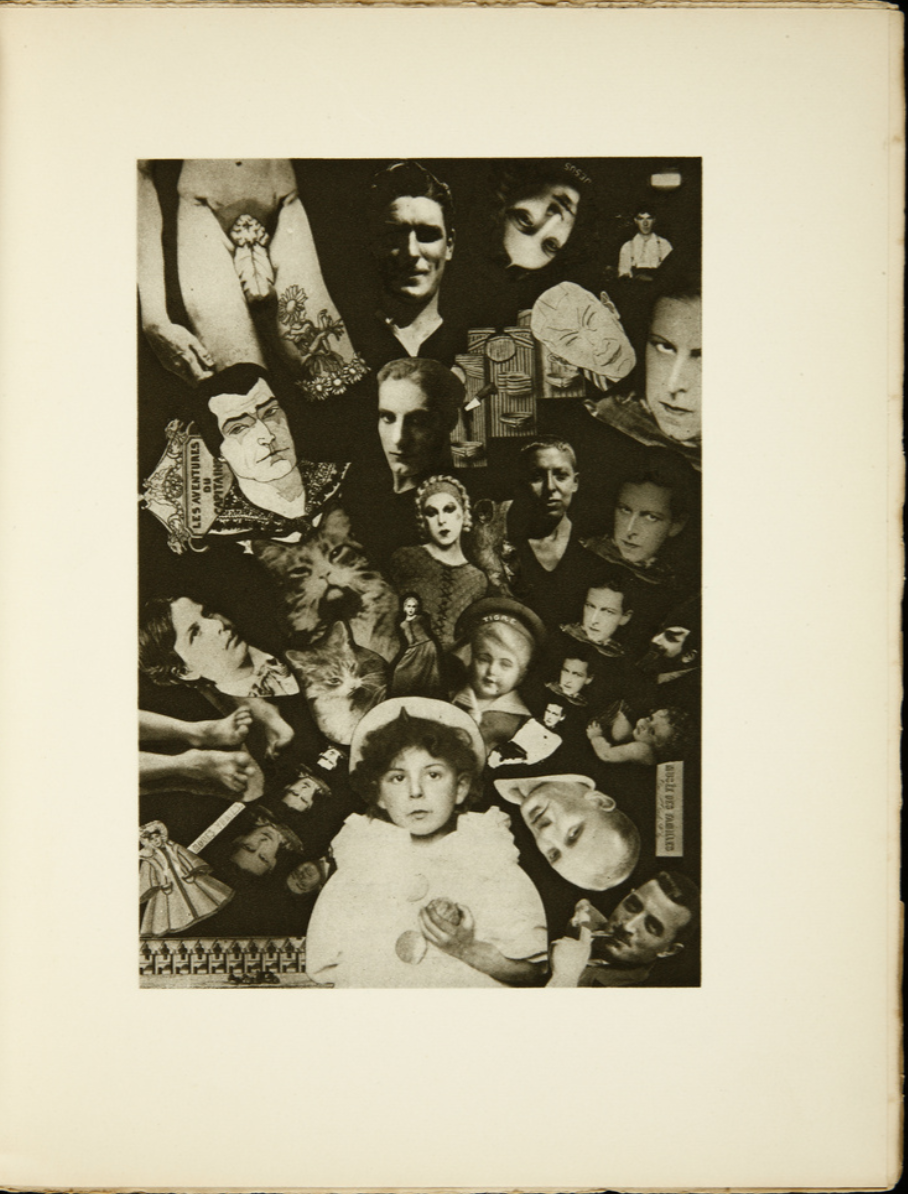
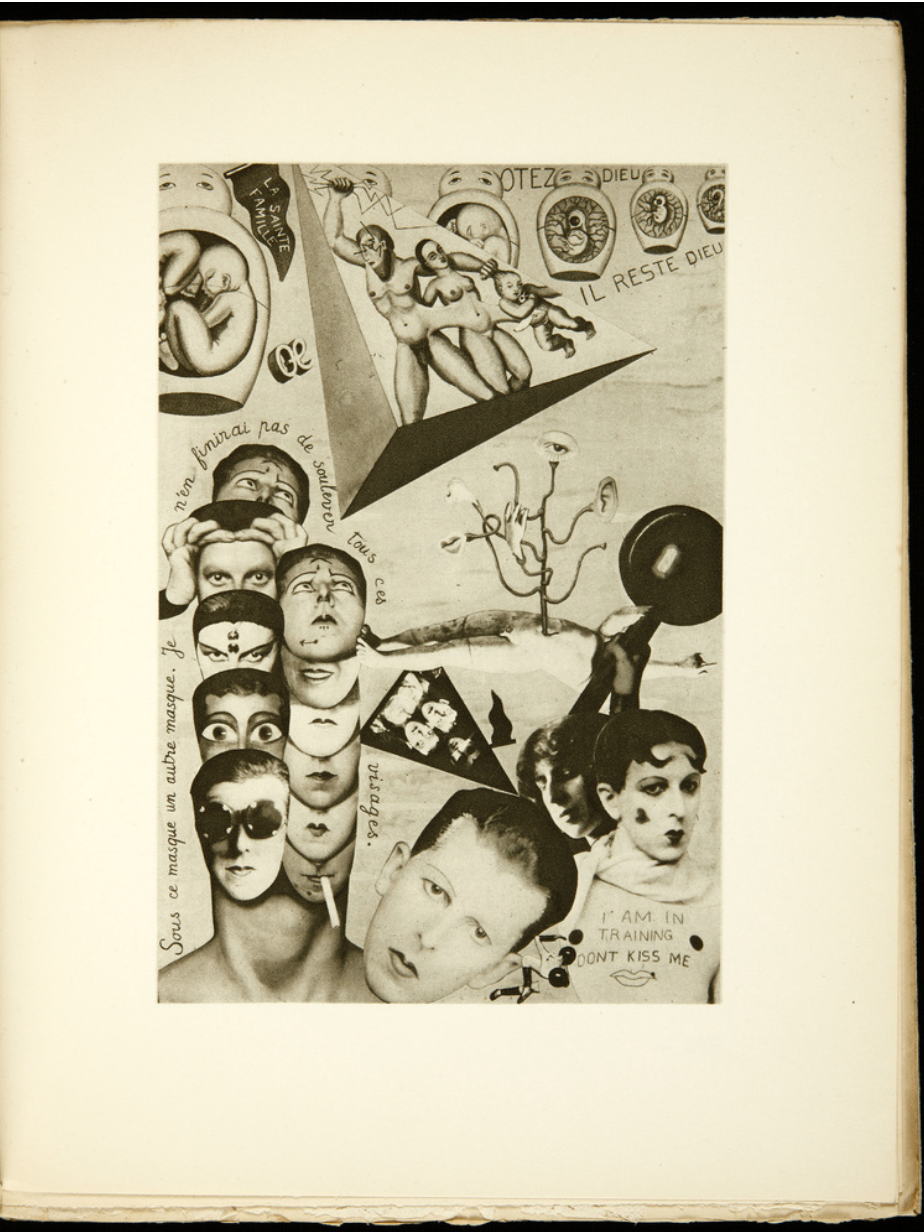
In the final photomontage [Fig. 3], images of generation are omnipresent, opposing the emblems of the Trinitarian (albeit paganized) and oppressive “holy family” with figures of efflorescence, division, self-multiplication, and twin birth—images that resist any fixed or crystallized identity and that continue to evoke the dialectic between self and other. The metaphysical dimension of this final image is mirrored by the second photomontage [Fig. 2], which stages the ordinary formation/education of a young girl dressed as a Pierrot. This functions as a prefiguration of the later rejection, in the first chapter, of traditional systems of education. Several elements of this photomontage merit closer attention: the prominence of severed heads, which in some cases, through visual effects, resemble heads served on a platter; the portrait of Edouard de Max, a well-known homosexual actor, in the role of Herod, placed next to a photograph of Lord Alfred Douglas; and finally, an inverted head of the Cristo Benedicente by Bernardino Luini, clearly evoking Leonardo da Vinci, and alluding to the St. John the Baptist housed in the Louvre—a painting that, in late nineteenth-century art criticism, was immediately associated with androgyny and homosexuality. These elements, which anticipate the crucial role the figure of Salome will play throughout Aveux non avenus, enact a shift away from the heterosexual regime of social reproduction and they foreshadow the text’s deconstruction of normative gender and sexuality.
Indeed, it is precisely the paradigm of exception that Cahun claims for herself:
See Nigro, Fotografia e fotomontaggio nella Parigi di André Breton, pp. 176-181. W. Pater, The Renaissance. Studies in Art and Poetry, U of California P, 1980, p. 93, writes: “Sometimes, as in the subjects of the Daughter of Herodias and the Head of John the Baptist, the lost originals have been re-echoed and varied upon again and again by Luini and others.”
It is a widespread commonplace in the late Nineteenth Century culture: see, for instance, L’androgyne (1891) and Le gynandre (1891) by Joséphin Péladan, or Walter Pater’s The Renaissance (1877). See also J.B. Bullen, ‘Walter Pater’s Renaissance and Leonardo da Vinci’s Reputation in the Nineteenth Century,’ Modern Language Review, 74, 1979, pp. 268-80;
J’ai la manie de l’exception. Je la vois plus grande que nature. Je ne vois qu’elle. La règle ne m’intéresse qu’en fonction de ses déchets dont je fais ma pâture. Ainsi je me déclasse exprès. Tant pis pour moi.
Cahun, Aveux non avenus, p. 170.
This challenge to normative frameworks becomes especially clear in Cahun’s rejection of any strict demarcation between masculine and feminine:
“Masculin? Féminin? Mais ça dépend des cas. Neutre est le seul genre qui me convienne toujours. S’il existait dans notre langue on n’observerait pas ce flottent de ma pensée. Je serais pour de bon l’abeille ouvrière.
Ivi, p. 169.
The choice of the neuter, on closer inspection, is not an incidental gesture but rather a core actualization of Cahun’s cosmogonic project. Following Roland Barthes’s reflections, the Neuter is precisely that which eludes paradigms—it refuses the logic of identity, assertion, productivity, and appears instead as a gratuitous movement toward alterity. In this sense, the Neuter is not the grey, the neutral, or the indifferent: “To outplay the paradigm,” writes Barthes, “is an ardent, burning activity.” It means “pervert[ing] the very structure of meaning,” searching for an “im-pertinent” expression—one that does not belong, that deviates. For Cahun, this entails stepping outside the paradigm of heterosexual production—on the level of life practice, knowledge production, and aesthetic form. It involves conceiving the subject eccentrically, in terms that exceed gender categories. Drawing on Monique Wittig, we could say that Aveux non avenus’s subject is a lesbian one, since:
I prefer “Neuter” to the English official translation “Neutral”, since it does not evoke neutrality or greyness.
R. Barthes, The Neutral, New York, Columbia UP, 2005, p. 7.
Ivi, p. 46.
Lesbian is the only concept I know of which is beyond the categories of sex (woman and man), because the designated subject (lesbian) is not a woman, either economically, or politically, or ideologically. For what makes a woman is a specific social relation to a man, a relation that we have previously called servitude, a relation which implies personal and physical obligation as well as economic obligation […], a relation which lesbians escape by refusing to become or to stay heterosexual. We are escapees from our class in the same way as the American runaway slaves were when escaping slavery and becoming free. For us this is an absolute necessity; our survival demands that we contribute all our strength to the destruction of the class of women within which men appropriate women. This can be accomplished only by the destruction of heterosexuality as a social system which is based on the oppression of women by men and which produces the doctrine of the difference between the sexes to justify this oppression.
Wittig, The Straight Mind, p. 20.
But let us return for a moment to Barthes’s argument. Among the figures of the Neuter, Barthes includes “the Leonardian smile analyzed by Freud […]: smiles at the same time of men and women: smiles-figures in which the mark of exclusion, of separation cancels itself, smiles that circulates from one sex to the other.” This observation is especially resonant for Aveux non avenus, which also opens with the Leonardesque smile of Jesus and the textual evocation of the “Saint Jean-Baptiste doigt levé”—an explicit ekphrastic reference to Leonardo’s St. John the Baptist at the Louvre. It is no coincidence that in an unpublished autobiographical text, Confidences au miroir (written between 1945 and 1946), Cahun recalls a visit to the Louvre with her uncle Marcel Schwob: “lui fascine par la Joconde… moi par le Saint-Jean-‘Bacchus’.” The association between the two paintings—already made in Walter Pater’s The Renaissance —serves precisely to highlight the androgynous nature of the figures.
The image of St. John the Baptist with raised finger, then, anticipates the appearance of Salome—a figure who, along with Narcissus and Eve, constitutes one of the three central figures through which Cahun constructs her cosmogony. These figures are treated as manifestations of the Neuter: extracted from their traditional paradigms and transformed into emblems of subjectivity, generativity, and sexuality—yet each reconfigured to suggest gender confusion, relationality, and regeneration.
It is no coincidence that these three figures often blur into one another: the story Salomé vaincue intermingles with that of Eve; the motif of the gaze links Salomé with Narcissus. Salomé, in particular, is the character who most profoundly unsettles gender connotations (at one point, Cahun even addresses her in the masculine). In Cahun’s poetics, the figures of Salomé and Narcissus are frequently superimposed—as in a number of photographs where Cahun appears in a mirrored pool of water, only her head emerging.
Barthes, The Neutral, p. 195.
Cahun, Aveux non avenus, p. 19.
Cahun, Écrits, p. 604.
Pater, The Renaissance, p. 93: “It is so with the so-called Saint John the Baptist 10 of the Louvre—one of the few naked figures Leonardo painted—whose delicate brown flesh and woman’s hair no one would go out into the wilderness to seek, and whose treacherous smile would have us understand something far beyond the outward gesture or circumstance. […] Returning from the latter to the original, we are no longer surprised by Saint John’s strange likeness to the Bacchus which hangs near it, and which set Theophile Gautier thinking of Heine’s notion of decayed gods, who, to maintain themselves, after the fall of paganism, took employment in the new religion.”
See E. Showalter, Sexual Anarchy. Gender and Culture at the Fin de siècle, New York, Viking, 1990, pp. 144-168.
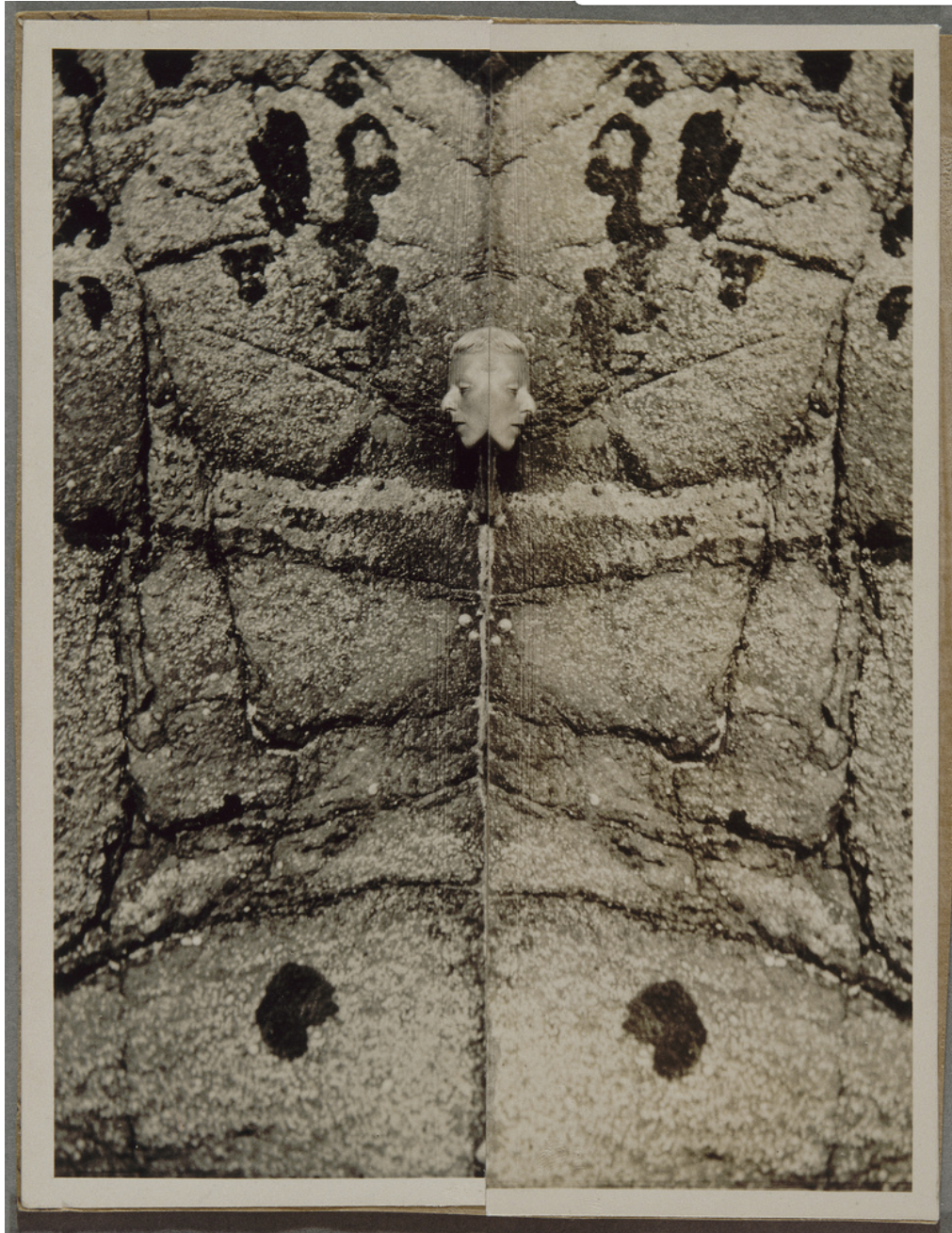
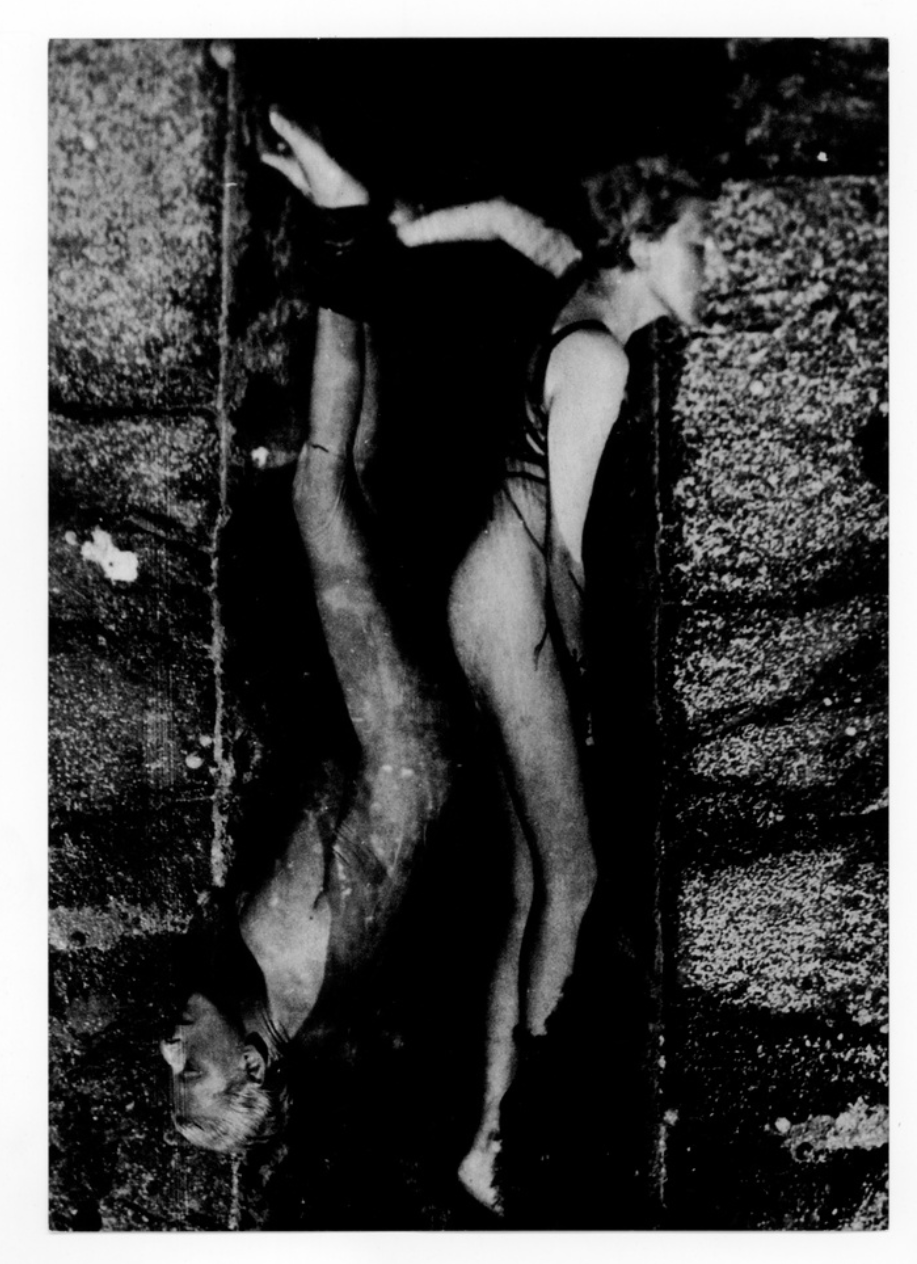
These images have often been interpreted as masked self-portraits staging the myth of Narcissus. However, two further references can be brought into play. In particular, the photograph of the duplicated face—almost resembling a severed head, immobilized on the water’s surface—clearly evokes a medieval version of the Salome legend, reimagined by Apollinaire in one of the stories from L’Hérésiarque & Cie:
Salomé, dont la belle danse avait sillé les yeux du roi, périt en dansant ; mort étrange qu’envieront les ballerines. […] Il arriva que, s’étant un jour d’hiver égarée seule au bord du fleuve gelé, elle fut séduite par la glace bleuâtre et s’élança dessus en dansant. Elle était comme toujours richement accoutrée et dorée de ces chaînes à mailles minuscules […]. Puis, les yeux mi-clos, elle essaya des pas presque oubliés : cette danse damnable qui lui avait valu jadis la tête du Baptiste. Soudain, la glace se brisa sous elle qui s’enfonça dans le Danube, mais de telle façon que, le corps étant baigné, la tête resta au dessus des glaces rapprochées et ressoudées. Quelques cris terribles effrayèrent de grands oiseaux au vol lourd, et, lorsque la malheureuse se tut, sa tête semblait tranchée et posée sur un plat d’argent. […] Comme une gemme terne, la tête demeura longtemps au-dessus des glaces lisses autour d’elle.
G. Apollinaire, L’Hérésiarque & Cie, Paris, P.-V. Stock, 1910, pp. 89-90.
This image also alludes to another cultural icon that gained great popularity in the 1920s and ’30s—especially among the Surrealists —namely, the mask of L’Inconnue de la Seine (The Unknown Woman of the Seine). As Anne-Gaëlle Saliot notes in a thoroughly researched study, the Unknown Woman of the Seine was not only a captivating legend but also an object—a product of technical reproducibility without an original. This hidden reference is particularly significant in relation to Cahun’s work because it touches on several key themes: the mask, mechanical reproduction, myth, the romantic mythology of the suicidal woman, and its ties to an archaeology of the male gaze. The allusion to the Unknown Woman of the Seine also appears in another sequence of photographs, in which Cahun’s head (through plays of reflection) seems to be enclosed within glass domes (The photo is available at this link:
https://www.navigart.fr/nantes-cahun/artwork/claude-cahun-lucy-schwob-dit-110000000123619?page=9).
This images almost seem like an illustration of a little-known story by Rachilde, an author whom Cahun was familiar with and who, throughout her life and work, also frequently challenged rigid gender systems (consider, for instance, Monsieur Vénus). In La Tour d’amour (1899), there is the head of a drowned woman preserved under a glass dome: the story’s lighthouse keeper searches for beautiful drowned women, whose heads he cuts off in order to kiss them (the reference to Wilde’s Salome is hardly subtle):
See B. Tillier, La Belle Noyée, Paris, Arkhê, 2011. In this regard, it is also worth noting the phototextual edition of Aurélien, featuring photographs by Man Ray, within the project of the Œuvres romanesques croisées by Louis Aragon and Elsa Triolet.
A.-G. Saliot, The Drowned Muse. Casting the Unknown Woman of the Seine Across the Tides of Modernity, Oxford UP, 2015.
For the relationships between Rachilde and Wilde see P. Dierkes-Thrun, ‘Oscar Wilde, Rachilde, and the Mercure the France,’ in M. F. Davis, P. Dierkes-Thrun (eds.), Wilde’s Other Worlds, New York, Routledge, 2018, pp. 220-41.
Elle est venue suivant une barque chavirée… morte à peine depuis deux jours, pas enflée, pas ver die, toute jeune la pauvre garce… et vierge… une demoiselle riche. Elle était accrochée par ses cheveux au gouvernail de la barque… des cheveux plus blonds, plus épais… (je lui en ai pris deux touffes près des oreilles, je les aimais tant…) Ils avaient encore un parfum de fleur… des fleurs de la terre… je l’ai gardée une lune… puis j’ai coupé la tête… pour mon dessert d’amour. Oui, bien bonne, bien douce, bien complaisante !
Rachilde, La Tour d’Amour, Paris, J. Ferenczi et Fils Editeurs, 1923, pp. 124-5.
This photographic series also evokes the image of the distorting mirror and the myth of Narcissus, since these are clearly self-portraits taken in the mirror.
The myth of Narcissus is perhaps the most pervasive within Aveux non avenus and once again reveals a regenerative process: it rejects the classical version of the myth in favour of a neo-narcissism founded on a different kind of relationality between two subjects — based on the recognition of the other:
Hors du narcissisme intégral, le couple se dédouble. Nous sortons de notre superbe isolement, nous empruntons au monde. Mon amant ne sera plus le sujet de mon drame, il sera mon collaborateur. […] Nous séparer. Nous masquer. Faire chaque nuit peau neuve et nouveau paysage. […] Nos désirs se rencontrent. Déjà c’est un effort que de les démêler.
Cahun, Aveux non avenus, p. 116.
The myth of Narcissus is particularly significant because it metaphorically embodies several crucial issues in Western culture, thus acquiring special importance within a work that aims to be cosmogonic.
First, Narcissus again alludes to the confusion of gender: Havelock Ellis (whose La femme dans la société Cahun had translated into French) in his 1898 essay “Autoerotism,” published in Alienist and Neurologist, compared a type of autoeroticism (especially female) to the figure of Narcissus and the situation of self-admiration in the mirror, which can also be observed in homosexuals (men with feminine minds): “This Narcissus-like tendency, of which the normal germ in women is symbolized by the mirror, is found in minor degree in some feminine-minded men, but appears to be very rarely found in men, apart from sexual attraction for other persons, to which attraction it is, of course, normally subservient.” Moreover, the myth of Narcissus is conceptually connected to the self-portrait, the visual genre that was certainly privileged by Cahun and frequently present in Aveux non avenus, even in verbal forms or textual genres that allude to autobiography. In this regard, it is worth recalling a sentence by Leon Battista Alberti, which James Hall has interpreted as “the seminal celebration of self-portraiture”: “I have taken the habit of saying, among friends, that the inventor of painting was, according to the opinion of poets, that [famous] Narcissus who was transformed into a flower. As the painting is in fact the flower of all the arts, thus the whole tale of Narcissus perfectly adapts to the topic itself.”
Finally, there is a strong link between the myth and subjectivism: Julia Kristeva in Tales of Love identifies Narcissus as a fundamental stage in the history of Western subjectivity:
See Leperlier, Claude Cahun. L’Exotisme intérieur, p. 138: “elle aimait reconnaitre en Havelock Ellis celui qui fut à la fois le premier théoricien du narcissisme et l’avocat de la communauté humaine, l’écologiste culturaliste, le sociologue artiste, qui s’efforça de promouvoir une utopie sociale au service des déterminations individuelles. Il apparait que ce travail sur le textes d’Havelock Ellis constitue un maillon essentiel qui favorisera la conjugaison de l’individualisme sceptique, esthète, des années vingt et de l’activisme politique des années 1930-1940.”
H Ellis, ‘Auto-erotism. A Psychological Study’, Alienist and Neurologist, 19/2, 1898, p. 280; See also H. Ellis, ‘The conception of narcissism’, The Psychoanalytic Review, 14, 1927, pp. 129-53.
J. Hall, The Self-portrait. A Cultural History, London, Thames and Hudson, 2014, digital edition.
L.B. Alberti, On Painting, Edited and Translated by R. Sinisgalli, Cambridge UP, 2011, p. 46.
Narcissus, however, appeals to us, and he is essential as a source of western subjectivism […]. The banality of his person (there is nothing heroic about the youth from Thespiae) as well as the insanity of his adventure (Ovid speaks of novitas furori, a new insanity) turn him into a borderline case indeed, but also a common one. Neither Dionysus nor Christ but tragic and immortal through floral metamorphosis, that lover of himself is strangely close to us in his everyday childishness. And yet he makes us uncomfortable, giving off a subtle uneasiness, a cold, sticky discomfort. As it at the start of a new era, the Christian era that led us to assume our humanity through the imposing suffering of Christ, insinuated in parallel fashion, not on the sacrificial heights of Calvary but in the dank, swampy, wastelands of human experience, that internality, that Psyche turned into psychicism, had a prince – a new insanity. Human, all too human. In short, there is infantilism and perversion on the brim of western internality.
J. Kristeva, Tales of Love, New York, Columbia UP, 1987, p. 115.
The myth of Narcissus is thus laden with political and cultural implications that affect the global dimension of the modern subject. As Christopher Lasch writes in The Minimal Self: “As the Greek legend reminds us, it is this confusion of the self and the not-self – not ‘egoism’ – that distinguishes the plight of Narcissus.” This state of uncertainty about the boundaries of the self, however, characterizes Cahun’s exploration—but in a euphoric sense: as the possibility of escaping the compulsory paradigm of choosing between “I” and “non-I” and being reborn, as a couple, as a two-headed monster (ce monstre à deux têtes). Kristeva also wrote that “The object of Narcissus is psychic space; it is representation itself, fantasy. But he does not know it, and he dies. If he knew it he would be an intellectual, a creator of speculative fictions, an artist, a writer, a psychologist, a psychoanalyst.” In this sense, we might say that Cahun’s Narcissus does know—indeed, he embodies all these figures together, and much more, in a process of continuous metamorphosis:
C. Lasch, The Minimal Self. Psychic Survival in Troubled Times, New York, W.W. Norton & Company, 1984, p. 19.
Kristeva, Tales of Love, p. 116.
Je peux croire à l’impossible, par exemple : Que Dieu, vous et moi sommes un seul et même lieu, que l’enfer, le paradis et mes draps se rejoignent, que l’instant, l’éternel, mes longues et mes brèves sont (pour qui saurait le dire) un seul et même mot.
Cahun, Aveux non avenus, p. 20.
The isotopy of metamorphosis is the primary one in Cahun’s work and represents the fundamental way in which the cosmogonic process is realized—a dialectical, almost apocalyptic procedure. References to apocalyptic themes are abundant: the flood, the year 2000, the Antichrist. We might even suggest that Aveux in the title implies both confession and revelation. In any case, metamorphosis always involves a dialectic of destruction and reconstruction: “Entreprise de démolition : / Est-ce vraiment là mon goût, mon amour ? C’est un pis aller. Je souhaiterais construire.”
This constructive work engages both the metaphysical dimension—as in the rewriting of Rimbaud’s Voyelles, where colours are thereby associated with profound anthropological questions —and the social dimension: it aims to change the rules of sociality and sociability. Not surprisingly, there are many ironic references to capitalism, finance, insurance companies, and the French campaign promoting natality after the First World War. For example, in the text Industries de luxe, Maecenas is a “déclassé méprisable,” poetry is co-opted by capital, and the Stock Exchange and the laws of supply and demand govern the world. In this inverted system, “l’amour pour l’amour, c’est dégoûtant.”
Often, this renegotiation of social rules passes through a reformulation of sexual values outside the norm—and therefore through the body:
For a discussion on possible interpretations of the title see K. Kline, ‘In or out the Picture: Claude Cahun and Cindy Sherman,’ in W. Chadwick, D. Ades (eds), Mirror Images: Women, Surrealism, and self-representation, Cambridge (Mass.), MIT Press, 1998, p. 78.
Cahun, Aveux non avenus, p. 161.
See ivi, p. 181.
Ivi, pp. 176-77. See also pp. 174, 179, 182 and 212. For the theme of natality see pp. 138, 162, 189, 211-2.
Faut-il que le monde soit mal fait pour qu’un être dépareillé, mais sexuellement sociable, soit contraint de se réfugier dans le crime comme dans un couvent, non seulement pour y vivre, même pour y créer ses valeurs nouvelles !
Ivi, p. 161.
The isotopy of metamorphosis is further articulated through six recurring figures, continuously reiterated throughout the text, which define the contours of Cahun’s cosmogonic project. Drawing on Marsha Meskimmon’s reflections on women’s aesthetics in art history, we might say that the project of Cahun and Moore signals a shift from “an ontology of being to one of becoming.” These six figures are: The rewriting and intertextual reference—especially to myths, fairy tales, and legends, that is, those foundational narratives of the imaginary and symbolic order; The image and situation of the mask; The monstrous body; The reference to alchemy; The overcoming of the ego/self; And finally, the confusion between genders.
Rewriting and intertextuality (visual in the photomontages and verbal in the texts) is one of the most evident features of Cahun’s entire poetics—consider, for example, the short stories collected in Héroïnes. Aveux non avenus advances in this direction, with the explicit intent to dismantle the symbolic order that imprisons women in a castrating mystique of femininity, confined within rigid boundaries that separate gender determinations. For instance, in Aveux non avenus we find a “Parsifal” in a gay rendition, with a double reference to the Arthurian cycle and the story of Sleeping Beauty, described as approaching “des roses defensives, car il s’est senti désigné pour éveiller le Prince.” Moreover ,there is a positive rewriting of the Biblical story of Sodom (in the brief Sodome, ville lumière); various Evas appear, including one in heat; references to the myth of Venus, which hovers throughout chapter III from the very photomontage, thus reckoning with emblems of female idealization; and Medusa, whose role, as Rosalind Krauss writes, is “the attack on the male ego—on its wholeness, its strength, and its stable center […]. An alliance with the Medusa is thus not an attack on women, but an assault on a viewer assumed to be male and an award to his fantasies of their worst fears.” There are also moments of reclaiming or distancing from Surrealism itself—for example, the distancing from the image of the woman-undine so dear to André Breton.
Sometimes the intertextual references are also assumed by the speaker, as if it were wearing, precisely, a mask: the “I” in Aveux non avenus, as Tirza True Latimer has pointed out, sometimes seems to lack a clear referent: “The mercurial narrator, who addresses an equally indefinite ‘you,’ inhabits a number of avatars.” Also, Marsha Meskimmon has argued that “The Cahun/Moore works did not formulate an aesthetic of self-revelation, premised upon an underlying truth, but an aesthetic of the self as stages, mediated, composed and composing—like photomontage itself.”
This aspect is further emphasized by the semantics of the mask (and masks, properly speaking, also appear in the photomontages): the act of masking is very often evoked or staged in the texts, sometimes reinforced by references to Carnival, makeup, or the performative dimension of acting and staging. These are almost always ambiguous references, which simultaneously imply the possibility of transformation (as in the already cited story Aurige: “Imaginer que je suis autre. Me jouer mon rôle préféré”), and the constraint of an imposed role, especially by the standards of femininity: emblematic in this second sense is Portrait de Mlle X, an anonymous young woman who, unlike Aurige, remains trapped within social expectations, her role imposed, a mask to stage the (coercive) expectations of gender performance.
As a counterpoint to this image, there is the third recurring figure I have identified: the staging of a monstrous body (which, as is well known, often characterizes feminist aesthetics): “j’élevais en moi de jeunes monstres,” writes Cahun. This is often a body cut into pieces, reassembled, part Frankenstein, part Patchwork girl: emblematic in this sense is the photomontage that opens chapter VII, where again the constitutive ambivalence of the signifiers is apparent: the body in pieces is a possibility but also the body devastated by the First World War.
The isotopy of metamorphosis also finds clear expression in the references to alchemy, a process that is in itself metamorphic, characterized by a death-rebirth cycle—it is no coincidence that there is an allusion to the ouroboros, the serpent biting its tail, symbol of the death-life cycle, of self-regeneration, and of the unity of the universe. Even here, however, the reference is altered in meaning: the aim is not the transmutation of metals, but a movement of becoming in the process of foundation or refoundation of relationality: becoming other, but also becoming thanks to, through, with, the other (or rather with the other woman). Thus, in Lettres d’Aurige au Poète, through a synesthetic poetics that certainly looks to the Baudelairean and Symbolist tradition, the philosopher’s stone is re-signified as an instrument of love:
M. Meskimmon, Women Making Art. History, Subjectivity, Aesthetics, New York, Routledge, 2003, p. 3.
Cahun, Aveux non avenus, p. 39.
Ivi, p. 54.
Ivi, p. 210.
R. Krauss, Bachelors, Cambridge (Mass.), The MIT Press, 1999, p. 19. For references to the Medusa myth in Cahun’s photography see also G. Doy, Claude Cahun. A Sensual Politics of Photography, London-New York, I.B. Tauris, 2007.
See Cahun, Aveux non avenus, p. 26: “Ainsi mon corps, et non point pur corps d’ondine jamais maculé d’âme, mais violé par la bête, sa marque, son parfum, le hasard de ses repas, de leurs reliefs”. See also G. Zachmann, ‘Femme surréalistes au service de la révolution,’ Melusine, XXXIII, 2013, p. 21, on women in the Surrealist Movement: “De la femme-muse ou fée, de la femme-enfant, – ange ou monstre -, l’auto-expression des femmes surréalistes propose, sans aucune ambiguïté, une autre figure de femme révolutionnaire : la femme-agent.”
T. T. Latimer, Women Together, Women Apart. Portraits of Lesbian Paris, New Brunswick, Rutgers UP, 2005, p. 44.
Meskimmon, Women Making Art. History, Subjectivity, Aesthetics, p. 96.
See C. Cahun, ‘Carnaval en chambre’, La ligne de cœur, mars 1926, now in Cahun, Écrits, pp. 485-6.
See Doy, Claude Cahun, p. 14: “Her avant-gard strategies and images are illuminated, I feel, by relating them not only to avant-garde practices but to mass-culture imagery of women involving make-up, masks and mirrors.”
Cahun, Aveux non avenus, p. 69.
Ivi, p. 26.
Saliot, The Drowned Muse, p. 62 noted that “Reconstructive surgery of the face became institutionalized as a proper medical practice in the years immediately following the war, with the return of the gueules cassées”. See also Shaw, Reading Claude Cahun’s Disavowals, p. 190.
See Cahun, Aveux non avenus, p. 55.
j’ai trouvé dans mon orgueil la pierre philosophale de l’amour. Avec elle, je puis accomplir la transmutation de joies : des signes, je ferai des sons ; des sons, je ferai des parfums ; des parfum, je ferai des baisers ; des baisers, j’obtiendrai des caresses…
Ivi, p. 74.
The poetics of the mask, alchemical transformation, and the disassembled body are all elements that converge in the fifth constant of this cosmogonic process, namely the overcoming of the self, in an attempt to multiply the self, which is also an attempt at transcendence and surpassing subjectivism (narcissism as traditionally understood), but not of subjectivity, in a constant process of becoming other and beyond one’s own self — it is that “neo-narcissism” repeatedly evoked in the text and which, according to Jennifer Shaw, also concerns a subjectivity “that does not fit with the conventional heterosexual paradigm.” The overcoming of the self continuously involves the affective sphere: “Mettre les mots, les choses et les gens (en amour) en facteur commun,” we read in Exercise sur deux notes. Or again, in one of the final texts of the work:
Ivi, p. 85.
Ivi, p. 125.
Œ – En vain j’essaye de remettre mon corps à sa place (mon corps avec ses dépendances), de me voir à la troisième personne. Le je est en moi comme l’e pris dans l’o.
Ivi, p. 223.
This is a particularly significant text because, as Federica Muzzarelli rightly pointed out, it expresses the possibility of viewing oneself from the outside through a capacity for recording that serves as a metaphor for the power of photography. But above all, I believe it is a concise survey of the relationality of subjectivity staged by Cahun: a being in becoming through recognition, mirroring as a form of relation — seeing oneself in the third person is also to see oneself reflected in the eyes of another, as was already suggested by the photomontage we began with.
In this respect, it is useful to return to the paradigm of the neutral explicitly claimed by Cahun: the eccentric subject who rejects the gender binary, the neutral subject, the subject in becoming through relationality, or, with Wittig, the lesbian as a subjectivity outside the patriarchal order. As Julie Cole has emphasized, “to call Cahun a lesbian is not simply to reference her sexual activities, but to invoke an entire series of cultural transgressions, including her personal and professional relationship with Moore, their mutual refusal to participate in a heterosexual economy […], and their production of a deliberately nonconformist visual identity.” The twin birth itself, found in the final photomontage — which, as we noted, is a complex of images evoking cosmogony — can be interpreted, according to Muzzarelli, as an allusion “to Cahun and Moore as a possible alternative life project.” In this sense, Cole continues, “the work’s greater subversive power lies in its creation of a viable space completely outside the patriarchal structures of heterosexual relationships, enforced femininity, and domestic servitude.”
It is therefore no surprise that situations and images blurring or complicating clear binary gender boundaries are extremely frequent: we find the classic references to the androgynous or hermaphroditic (“Les amants trop heureux forment un couple pareil au monstre hermaphrodite ou encore aux frères siamois”); the revival of a topos typical of late nineteenth-century narrative that Elaine Showalter labelled “male romance,” where images of male generation often appear — here, for example, the brief fable Clairvoyant, in which two men, thanks to the “semence philosophale,” marry and conceive a child, while the narrator’s irony targets the conceptions of normal sexual origin and, above all, the myths surrounding the mystery of femininity (the “dark continent” of sexuality, as Freud called it) and woman-as-nature. Yet, more often than not, this confusion aims at abolition:
Muzzarelli, Fotografia e femminismo tra 800 e 900.
J. Cole, ‘Claude Cahun, Marcel Moore, and the collaborative construction of a Lesbian Subjectivity’, p. 349.
Muzzarelli, Fotografia e femminismo tra 800 e 900, p. 86.
Cole, ‘Claude Cahun, Marcel Moore, and the collaborative construction of a Lesbian Subjectivity’, p. 349.
Cahun, Aveux non avenus, p. 40.
Showalter, Sexual Anarchy.
Cahun, Aveux non avenus, p. 55.
Je viens d’entendre mon rire qui n’a guère changé, et j’ai compris qu’en face de la mer, de l’amour, de toutes les forces élémentaires (nous abdiquons si volontiers !) il n’est plus d’âge, ni de sexe, ni même de personne – ni peut-être de séparation possible entre les âmes et les corps qui cherchent à s’unir.
Ivi, p. 89.
The search, the metamorphosis, aim at an indeterminate gender, as Cahun herself defines it, while simultaneously revealing the subversive force of this rupture: “Un genre indéterminé… Mais devant les denrées sans étiquette, les voilà tout désorientés… L’affichage est obligatoire.” If Monique Wittig is right when she writes that “for ‘woman’ has meaning only in heterosexual systems of thought and heterosexual economic systems. Lesbians are not women,” then the work of Cahun and Moore—through the development of a cosmogonic project that directly confronts the patriarchal symbolic order—aims to define an aesthetic and paradigm of the neuter in a strongly situated and political sense. “I add: a reflection on the Neutral, for me: a manner – a free manner – to be looking for my own style of being present to the struggles of my time.”
Ivi, p. 143.
Wittig, The Straight Mind, p. 32.
Barthes, The Neutral, p. 8.